
Henry Hub Horizons
LNG capacity through 2027: the price story is regime-dependent, the corridor story isn't.
The US is on track to add 7 Bcf/d of LNG export capacity through end-2027. The price impact depends on the regime. The corridor impact arrives regardless.
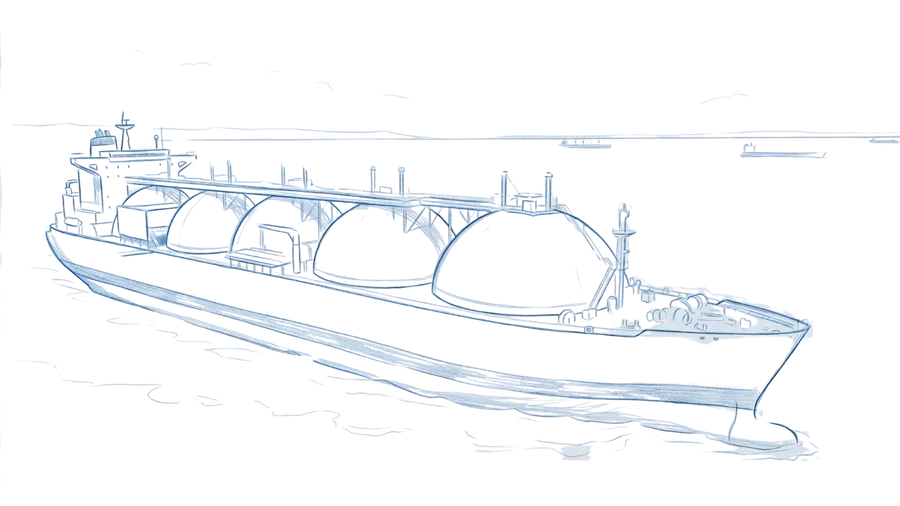
The US is on track to add roughly 7 Bcf/d of LNG export capacity through end-2027. That sink already exceeds residential consumption as a slice of US demand. The price impact depends on whether we land in a tight-global or oversupplied-global regime. The corridor impact arrives regardless.
The capacity wave is documented. Plaquemines is ramping through 2025–2026, with both phases targeting full operation. Corpus Christi Stage 3 is finishing its ramp across 2026 into early 2027. Golden Pass brings later trains online across mid-2026 through 2027. Rio Grande LNG Phase 1 and Port Arthur LNG Phase 1 begin exports from 2027. US export capacity moves from a mid-teens base at the start of 2024 toward the low-20s Bcf/d by end-2027 — the mid-20s come into view by 2029 if Mexico-linked volumes are included.
The price story is regime-dependent for a reason. US LNG exports grew nearly 24x between 2016 and 2024 without commanding sustained Henry Hub strength — outside of idiosyncratic episodes like 2022, record exports in 2023 coincided with Hub near the mid-$2s. What this build changes is the structural floor, not the everyday print. In a tight global setup with US supply under-performing, the larger inelastic export sink fattens the right tail meaningfully. In a global oversupply setup — IEEFA's case for 2026–28 — utilization runs toward contract minimums and Hub trades on weather and storage as it always has. In its April STEO, EIA put the 2027 average near $3.18.
What's invariant across the regimes is the corridor reshaping. Plaquemines pulls through Gator Express, Texas Eastern, Tennessee Gas, and Transco from Haynesville and Northeast supply. Rio Grande LNG draws through the new Rio Bravo lines — 4.5 Bcf/d combined — off Agua Dulce. ADCC is in service feeding Corpus Christi. Whistler, Matterhorn Express, and Blackcomb — the last targeting late 2026 — move Permian molecules to coast. Some are purpose-built terminal laterals, some are expansions on established Permian-to-Gulf routes. All clear through the same Gulf Coast network that prices at Henry Hub. The molecules move regardless of the regime.
The price desk will read this regime by regime. The corridor desk reads it in the feedgas notices that move first.