
Henry Hub Horizons
Hyperscaler gas demand is moving behind the meter. The dispatch models haven't followed.
Hyperscaler behind-the-meter gas demand is now on the order of 100 GW announced. It pulls gas from the market but not through the dispatch system traders forecast on.
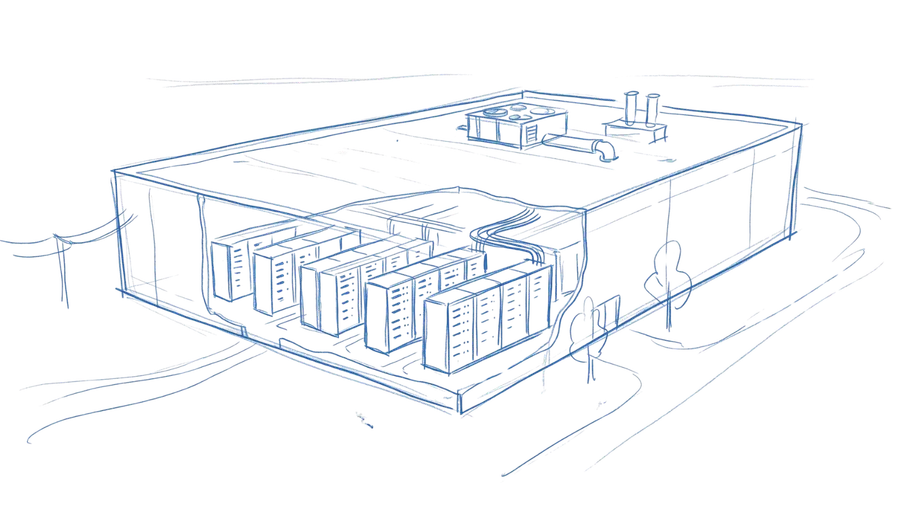
On the order of 100 GW of behind-the-meter natural gas generation has been announced for data center developments, with a significant share already at the equipment-order stage. That demand pulls gas from the market but not through the dispatch system the power-burn forecasts are built on. The visibility gap is what's worth talking about.
Deal certainty varies across the announcements. Oracle has contracted a 2.3 GW BTM gas generation fleet with VoltaGrid across multiple Texas sites, backed by firm fuel supply from Energy Transfer's pipeline network. CalEthos, through its TerraVolt subsidiary, signed a 55,000 MMBTU/day gas supply agreement in May 2026 for its Southeast Idaho BTM project. Microsoft is reportedly negotiating a 1.4 GW BTM project in West Virginia and is in exclusivity talks with Chevron and Engine No. 1 over a 2.5 GW West Texas plant, with turbines already ordered but no definitive agreements finalized. The mix represents multi-year capital commitments that don't reverse on quarterly timelines.
The measurement gap is mechanical. Regulated power-burn forecasts are built on dispatch data from ISO and RTO grids, which captures gas-fired generators connected to the regulated system. Behind-the-meter generation by definition isn't on that system; the fuel pulls from interstate pipelines like any other but the demand signal lands in pipeline nominations rather than dispatch logs. FERC's December 18, 2025 order directing PJM to revamp its BTM colocation rules, and PJM's February 2026 compliance proposal for a three-year transition through 2028, codify the structural distinction at the regulatory level. EIA short-term models, AEO scenarios, and broker-desk consensus on burn are largely anchored to dispatch-based views. As BTM scales through 2026 and 2027, the risk of underforecasting isn't proportional. It's structural.
The scale relative to total US gas demand is the part that's easy to miss. At a 60% capacity factor and a typical CCGT heat rate near 7.6 MMBtu/MWh, on the order of 100 GW of BTM gas generation implies roughly 10 to 11 Bcf/d of gas demand. Current total US gas demand sits in the low-90s Bcf/d per recent EIA STEO releases. Even a fraction of that capacity operating represents multi-Bcf/d of incremental demand that doesn't show up in the dispatch numbers.
For traders pricing burn against dispatch-anchored forecasts, the gap is a state-variable getting larger by the quarter. The dispatch numbers will keep printing. The system they describe is shrinking as a share of the actual gas balance.
Dispatch was the right window for a decade. It's a smaller window every quarter.